Tag Archives: writing

The Pros and Cons of these Trader Joe’s Cats Cookies I Bought Last Week

Destructive and beautiful.

Pro: They’re delicious.

I’m more than satisfied with the cookies’ taste, which has a good amount of cinnamon and is sweet but not too sweet. The crunchiness is quite appealing, yet I never feel I have to work too hard for them to give up their tasty inner-workings.

Con: They’re delicious.

Damn these cookies! They are so small that it feels to me each one merely introduces the depths of their tantalizing flavor! It never satisfies the cinnamon hunger that it awakes. But I can never move past the initial “hello, I taste great.” One cookie is just enough to pique my taste buds and get them wanting more. Always more! Madness!

Pro: They’re small.

I think “oooo! I’ll just have about three with my coffee and that’s the perfect snack size for 5 o’clock coffee. Just three small, crunchy, cinnamon cookies from the huge container I keep right on my desk, right within reach. No more, no less. This is great!”

Con: They’re small.

They’re too small! They’re so small I can always have another one, or at least think that I can always have another one. What difference does one more tiny cookie make? What about five more? Twenty more! INSANITY!

Pro: They’re numerous.

For so many cookies, they were certainly a steal. 15 cookies is one serving, and there are 15 servings in a container which means 225 cookies, which would last me over two weeks if I just ate one serving a day. Wowzers! So cheap!

Con: They’re numerous.

There’re so many of them I can always convince myself that just one more cookie won’t hurt, that the actual level of cookies in the container will never go down, that the supply will never be depleted, even though I know, beyond a shadow of a glimmer of a doubt, that these cookies are numbered and they surely will end, and just as the earth itself is counting down its days to the final destruction when the sun blows up in billions of years, so will these cookies end, because there are at maximum 230 cookies in there, depending on weight discrepancies.

But my dumb psychology tells me that one more cookie has no real effect on the sum total of the cookies, even when there is mathematical, scientific, arithmetic proof that it does, but this is the Cats Cookie madness, and it is inescapable. My only hope now is that the cookies are gone in less than two weeks, which they surely will be, and that I don’t have enough motivation to drive all the way to Trader Joe’s again in order to purchase them, which I would likely do in a moment of weakness because I lay in their thrall. Help me.

Cookie anyone?

Tagged , , , , , ,

Fake Backstories of San Francisco Neighborhood Names: The Sunset

When living in the city gets too exciting, head to the sunset.

Stanley Kubrick loved to eat dry toast in the morning. A tortured, artistic, soul, he refused to put anything on his bread to soften its coarseness or ease its transition down the gullet, as he wished to be reminded of the dull, dryness of everyday life and its sad, petty cruelties, all of which he captured in his film 2001: A Space Odyssey, which he filmed in San Francisco in the neighborhood to be known as the Sunset.

The filming of 2001: A Space Odyssey took over ten years, largely because Kubrick insisted that the bulk of the movie be endlessly interweaving psychedelic patterns that he created by rearranging small pieces of colored felt on a gigantic black felt board. Because of the area’s damp climate, the felt board would invariably become wet and unusable from fog moisture, which leaked into the studio despite his best efforts, and the team would regularly shut down filming and have a pint or two at Durty Nelly’s, where Kubrick would always talk at length about the dry toast he ate every morning. After the fourth year, the film crew tired of the same spiel and especially the phrase “petty cruelties,” so it was a great relief when the film was finished and released to great critical acclaim, something that surprised everyone without exception. Stanley Kubrick ate an extra slice of dry toast the morning he read the NYT review because he tended to quash feelings of excitement with bland, unpleasant food.

At the time of Kubrick’s film involvement in San Francisco, the Sunset was called Fogtown, which was an accurate name though the residents hated being dismissed as fog dwellers and portrayed in the media as “too moist to be human.” The fog people would often protest the rampant media prejudice in the Financial District during lunchtime, when they would blockade the entrances to sandwich shops, cafes, and public transit entrances with their very bodies. The distress was unbearable and the stock market suffered accordingly after every suit was forced to pack a lunch during a full week of lunchtime lie-ins. The police department decided to take action.

Stanley Kubrick, an artiste, decided that the only proper way to experience the film of his heart’s desire was to project it on a sheet that blanketed a building, and shut down the entire downtown area in order to subject movie-comers, hot dog vendors, and passers-by alike to his brilliance. Besides, the fog people were planning another protest on the day of the movie’s release so most people were prepared for mayhem and un-productivity. Secretly, the police lay in wait with banana cream pies with which they would lure the fog people’s off their soggy bottoms and away from sandwich shops.

A carefully orchestrated blackness descended over the city, summoned from the incredibly disturbed and misunderstood mind of Stanley Kubrick. As the movie flashed onto the screen, downtown bustle ground to a halt, the only noise heard the occasional flapping of a tourist’s map. In the alleyways, police readied their pies for the fog people.

The film meandered, reached its climax somewhere, and then denouemented and ended. The crowd lay, sat, stood, or leaned in awe and confusion at what they had just seen. Munching on a piece of dry toast, Kubrick rose and spoke a few words, the most important of which were these:

“This was filmed in Fogtown over a period of ten years. I have grown old there and am now reaching the sunset of my life (he wasn’t actually old—he was just being dramatic), and I remember a day in January three years ago, when I saw the sun sinking into the ocean and imagined myself as similar to the sun, a brilliant orb also seeking the depths, which I have found now in the sunset of my years because of this movie (again, he’s just being dramatic), and in the neighborhood that shall now be known as The Sunset.”

And the people did cheer and everyone did eat banana cream pie and the name stuck.

And that was fake history. Because research takes time.

Tagged , , , , ,

I’m not a local, but then again, who is?

So cliche.

I was born in Colorado, spent three years in West Virginia, lived in Oklahoma for middle and high school, went “back east” to Boston for university, and then farther east to Egypt, and then even farther east to San Francisco.

To many people in California, Oklahoma is just as exotic as the Lost Kingdom of Thormasgurd, except no one wants to know more about Oklahoma. They assume things are radically different “out there” and they’re usually right. Sometimes they even express a fear of going to the middle place in the US because it’s a lawless, conservative backwater where people tie jackets around their waists, and I encourage this by tightening my cardigan around my middle and yelling “Yeee haw!” every time I meet someone.

I remember the first time my parents visited me at Boston University. I’d been away for all of eight weeks or less when they visited in early October, but on the way to Legal Seafood, I felt compelled to show them how city-savvy I’d become by wearing an eggplant J. Crew sweater and jaywalking, often stranding my parents on opposite sides of the street. Instead of proving myself an adroit city-dweller, I pissed off the parentals through my reckless walking behavior and ended up feeling dumb and sweating because it wasn’t cold enough to be wearing a sweater and speed walking.

Over the course of four years, and it did take me four years because I’m a slow realizer, I found that I would never be a local in Boston, that somehow my Oklahoma roots were standing out ever starker on the scalp of my collegiate experience (unwise metaphor?), and that, to my never-ending surprise, I was actually encouraging it, getting involved in things like stew-making and contra dancing and prairie-dress-wearing. While in the northern wasteland, I found comfort in identifying with a mostly mythological Oklahoma, not at all the same one I had mildly despised while growing up. The Oklahoma in my collegiate mind was something else. It was a warm fire in winter and a sense of belonging in a place where everyone was far from home.

Now in San Francisco, I’m finding the same phenomenon to be true. Though I haven’t lived in Oklahoma for roughly five years, it’s still the place I’m “from,” and I will likely be from there my entire life. In cities like San Francisco, many people are in a similar boat. Maybe not one quite as conservative or mythologically rich, but most people are not “from here.” Many are from other parts of California or other states on the West Coast, and they’ve been drawn to the hilly flame of San Francisco like hapless moths, just like I have. Quite often there’s nary a local to be found.

Being a local is a kind of rare currency in this city. It connotes intimacy with a place that so many people desire, and it’s something that can’t be bought or earned. It can only happen or be given by parents foolish enough to try to withstand the expense and private-school calculus of raising a child in the city.

I will never be a local here, no matter how asymmetrical my haircut is.  The only place I am a local is back in Oklahoma. I think that makes me a continual explorer, but it also adds the burden of creating home every place I go, but I guess that’s what we all have to do anyways. At least I’m in good company.

Tagged , , , , , , ,

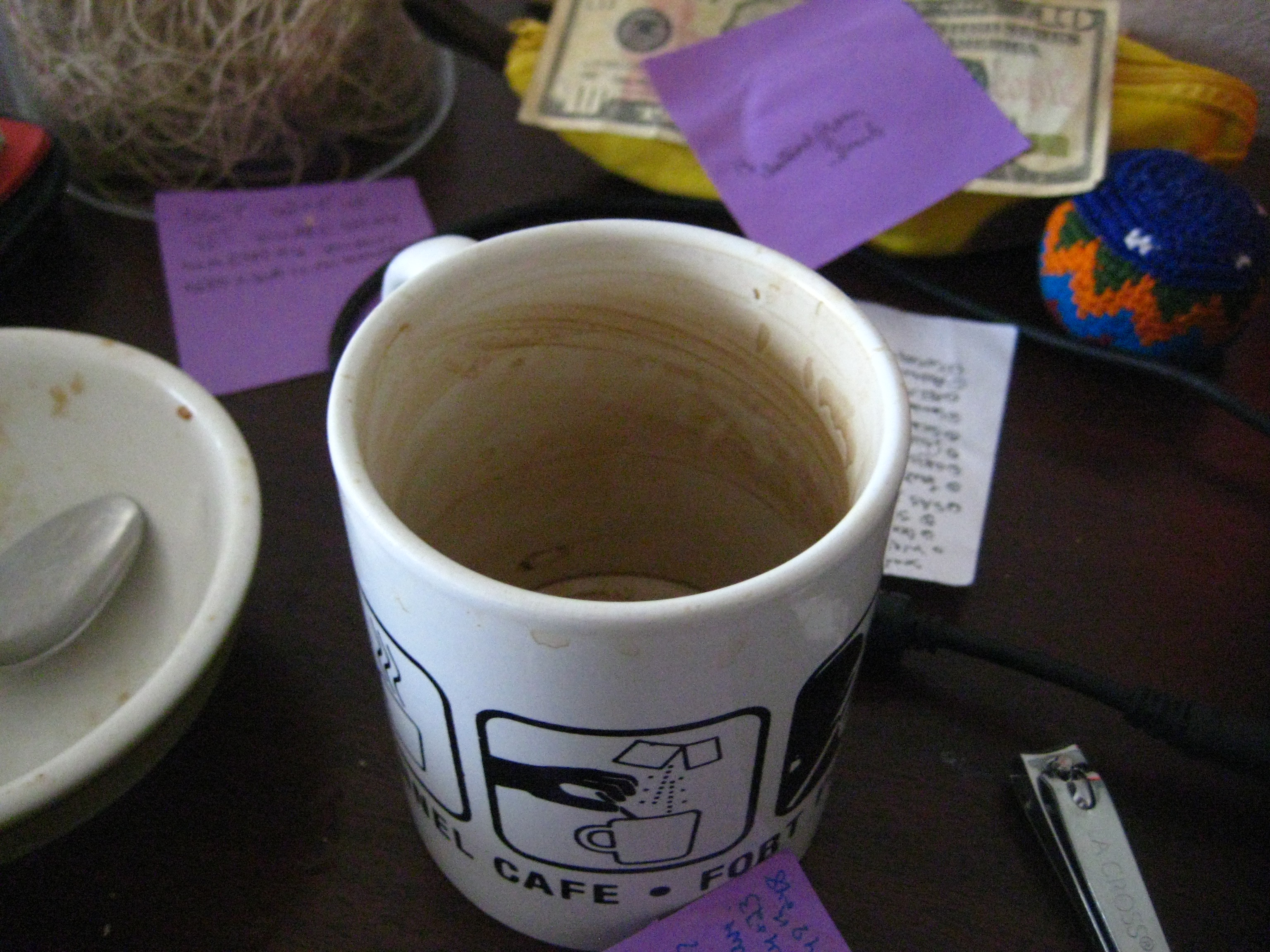
What Do You Do When the Coffee’s Gone

Is there anything sadder? Besides the poem, that is.

When the lamp is on, and the chair is warm, and the coffee’s gone, what do you do?

Where do you go when there’s nothing there, not in your cup, not a drop to spare?

What can you pray, to take the pain away, to smooth the rough edges of another rough day?

What do you know that can whisper to your soul, the way the coffee does, when you’re feeling so low?

And the loneliness is pressing, the wind whipping round, the chill to your bones, the stale coffee grounds.

The dry brown ring, the sad coffee stain, the slight dampness mocks you and your coffee-addled brain.

Oh sweet Lord in heaven

Oh red Devil in hell

I don’t care who I pray to, as long as it breaks the spell

This endless white emptiness, the crushing heartache, the yearning and hoping as I’m lying awake.

For a cup of coffee. Hot. No sugar. Just milk. Please.

Then we can have conversation and pass the pleasantries

And thoughts will float between us, as they do between old friends. That is, as they do, before the coffee ends.

Tagged , , , , , , , ,

Fake Backstories of San Francisco Neighborhood Names: Dogpatch

On some days you can still smell the toupee glue.

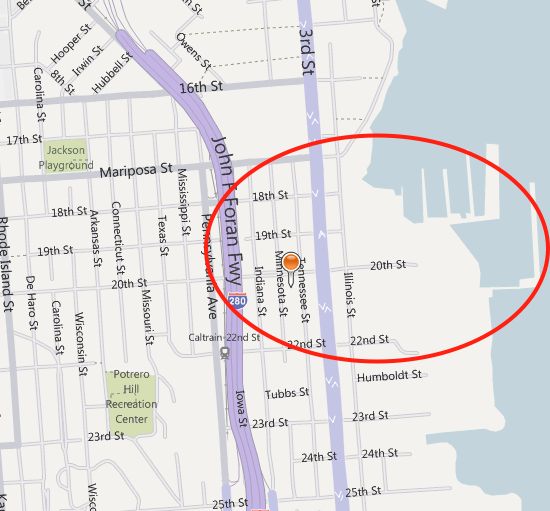
Dogpatch boasts one of the most unusual and other-worldly histories of all the micro-hoods in San Francisco. It borders Portrero Hill, a hamlet where a baby invented Kobe beef while high on marijuana, and on its other sides, Dogpatch nestles against the Bay and the lower armpit of SOMA, which occasionally splashes it with techie gang activity.

Its name history begins long ago, back when San Francisco was a playpen for 15-18 year olds who ran away from their homes in order to use drugs in parks, when the area to be known as the Dogpatch was dominated by a toupee factory. Don Ricketts was the name of the toupee factory founder and owner, a man who weighed 444 lbs and never left home without a fedora and a pair of scissors. He was married and divorced by the age of 16, and knew since then that his only love would be synthetic but realistic-looking hair for men and women and even a couple of canines.

For years, he ran the factory with a vicious regularity, churning out more piles of toupees than any other factory on the West Coast. Every night, Don would grin at closing time as he watched the merchandise go into storage, salivating over the predicted aging of the US population. So many bald spots to cover.

Then he was abducted by the aliens.

Lying in bed one night, looking out the window with his face mashed against the pillow, he noticed unusual light activity exactly where he often watched the colors change from red to green to yellow to red to green to yellow. There was purple and blue. And then a giant eye. And breaking glass. And something gooey. And then nothing.

When Don Ricketts returned to earth, he drooled uncontrollably and had lost all interest in synthetic but realistic-looking hair for men and women and canines. He laid off every single worker, except for the ones who knew how to brew a good cup of coffee, sold his factory with the caveat that he would always be able to sit and drink joe at the company café, and surrounded himself with drooly dog friends, partially for scientific study in order to determine the cause of the over-salivation, but mostly for companionship and the hair. He loved touching their very real, very long, dog-hair.

At the time of his death, he had exactly sixty-eight dogs, all of them named Patches, and all of them incredibly drooly. In his will, he specified that a shelter be built for them on the spot of his old café plus the surrounding area, and that it should become a park for droolers everywhere, both human and canine.

These provisions of the will were ignored completely, as Don Ricketts had no surviving family and only a resentful ex-wife. The dogs were indeed provided for, but the area designated to be a park was instead sold to other enterprising men and women, and the area became a gross industrial town that retained only the name of Don Ricketts’ dogs, which over time became corrupted to the present-day “Dogpatch.”

And that was fake history. Because research takes time.

Tagged , , , , , ,
Design a site like this with WordPress.com
Get started