Tag Archives: culture

Postal museums: people are stamp-eding to get in

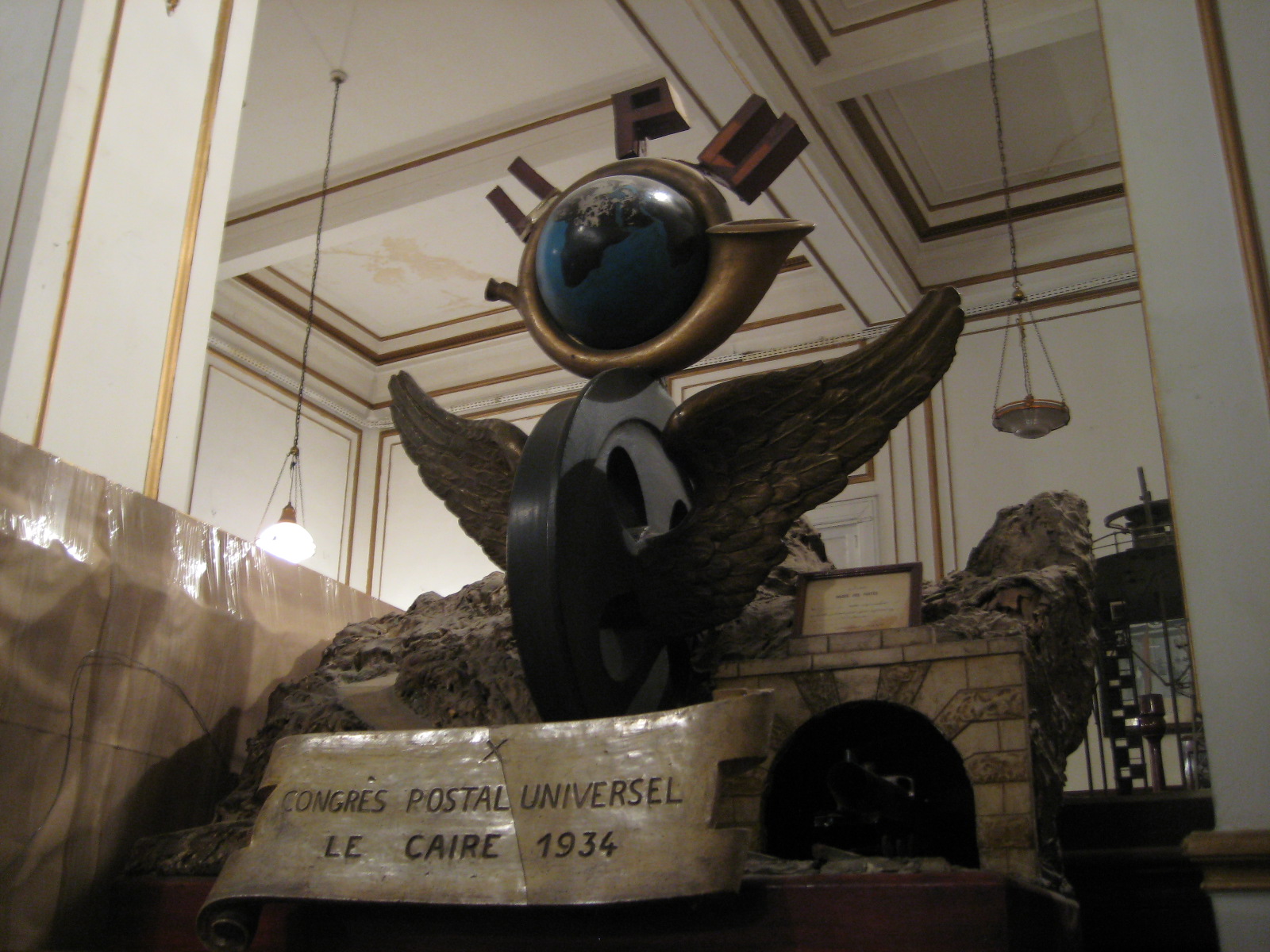
View from the couch. Also, the only picture I took before my camera died. The only man who knew what this is has gone insane.

Today, just as the Egyptian army began activist clean up and put away time in Tahrir square, three happy go lucky American students arrived safely though thirstily at their apartments after a riveting day of museum hopping and fame snatching. If all goes well, I will be leaving my program shortly to begin my career as a full-time documentary interviewee specializing in Egyptian museums. Allow me to explain through the medium of story telling:

After the spiritual revelation that was the Egyptian Agricultural Museum, our group formed an unspoken consensus that we must taste the dust of every museum in Cairo that lies off the beaten path. Little did we know that our destinies and the destiny of one founder of pastpreservers.com would soon collide.

The next stop on our list was the promising Egyptian Postal Museum, a mecca for mail enthusiasts from all over Egypt and the world that attracts up to ten visitors a year. Incredibly, we almost missed the museum itself even though it was unlabeled and tucked away on the second floor of the national post office. When we arrived, the museum/postal worker found the key and opened the door for us to a one-room world of postal wonders. Dusty glass cases contained everything from international postal uniforms, stamps, miniatures of famous postal offices in Egypt, and figurines of postal workers from different time periods. It was more than I had ever wanted to know about Egyptian and worldwide mail delivery. Luckily, I avoided learning too much.

Personally, my favorite part of the museum was the couch and nearby fan whose blade was left unguarded, an element that added a thrilling level of excitement to what could have been a boring place. My heart raced as I gingerly stepped by the fan when I reluctantly got off the couch, nervous it would catch my chinos and begin boring into my flesh. I made it by safely, though I never made it back there after my short rest at the start of our visit, my one regret. I also regretted the fact the museum did not have air conditioning, a complaint I plan to tweet at the Supreme Commander of Armed Forces.

The museum was mustical, but the real magic happened as we were leaving. Turning to go down the stairs, I was shocked when I spotted another white guy on the ground floor peering up at us with equal puzzlement. We both thought to ourselves, “No way these people came all the way out here like us freaks to see the postal museum.”  It turns out we were both wrong. Our groups gave each other the up and down as we descended the spiral staircase and as we were about to walk by him and out the door forever, he confronts us.

Tension reached its peak for a brief moment but then he tells us that he works for an Egyptian television station and that he and his television crew are doing a piece on lesser known museums in Egypt.  He is surprised anyone else knows about this place and asks if we would like to be interviewed. Obviously, fame grubbers and blabber mouths that we are, we eagerly agree. The film crew sets up and the host of the show asks us hard hitting questions in passable English like “Is this your first time in Egypt” and “What was your favorite part of the museum?” Unfortunately for my friend, right before we began filming, I had  jokingly said “So will we be singing? We know a song in Arabic!”

So he had a surprise question as well, “Do you know any songs?” It was a cheap shot, to be sure, but I can’t say we (I) didn’t ask for it. If all goes well, you will see a short interview and song by us on Egyptian television (channel 25) after Ramadan.

SNEAK PREVIEW: Emily loves the couch!  Lack of English labels might be a problem for some tourists!

It’s pretty riveting stuff so I can understand why the people of Egypt are anxious to see it before the end of Ramadan. There will probably be another Tahrir sit in because of this…so much for life back to normal. #revolutionmyway

Tagged , , , , , , ,

Twas the night before Ramadan

Some Ramadan decorations…not the most impressive, just the closest

Twas the night before Ramadan and all through the flat,

No one was stirring, not even the mat

In front of the bathtub in spite of its mold,

Not to mention the pile of laundry to fold.

Emily was curled next to her laptop with care,

Playing too much with her freshly washed hair,

As she wondered what sights the morrow would bring,

The possibilities all in her head turning.

She had seen sprucing up for the past several weeks,

Lights and lanterns appeared and people clogged up their leaks.

She saw tapestries hung all full of colours bright

Pleasant figures in Alpha Market’s window one did spy,

The buzz in the air causing life to blur,

Evidenced by families buying twenty kilos of sugar.

“But,” she wondered, “how will this affect me,

I who have not yet embraced muslimery?

When will stores be open and how should I eat

if I cannot slaughter pigs on the street?

And what about alcohol, if I may be so bold?

Where will my 8th rate beer be sold?”

Oh life without urine-like drink did sound foul,

And just when she thought of giving a howl

She remembered the wonder of Ramadan here.

The streets, they say, be they far or near

Fill up with people as the sun departs

From sidewalk to sidewalk citizens satifsying their hearts

And their stomachs with delicious iftar vittles,

Not being shy, or taking too little,

Dates being thrown into the car windows of those

rushing home from their shops after they’ve just closed.

“Oh I wish,” she thinks,  “to eat with these folk

and though I’m not fasting I will hardly croak

at being invited to such a magnificent feast

where I will chow down on all kinds of roast beast.

“Until then,” she informs, “I still do not know

at what hours for my peanut butter I may go

to Alpha Market and for that matter

I remain clueless as to types of Ramadan clatters.

So please stay tuned as I absorb more culture

and I will pass it on to all of you for sure;

less facts than feelings as is my wont

But at least you’ll know all my favorite haunts.”

No complaining.

A few notes: I’ve noticed people buying food in ridiculous quantities at all the supermarkets, which have set up special Ramadan sections with all the necessities for having a proper iftar (break fast, occurs after sundown). One of the most important foods are dates, which are traditionally the first food one eats after fasting all day. Apparently people hand out dates to those struggling to get home in traffic or on the metro before the iftars. Water is also distributed since people fast from both food and drink.

I have been told about big tents that are set up all over town where rich people will prepare huge feasts for the less fortunate, and entire streets are full of those breaking the fast together. If this is real, I will take a picture of it. I will then post the picture onto this blog.

No alcohol may be sold to Egyptians during Ramadan (I think. This might just apply to bars.) and so you have to show your passport in order to get a beer. The hours for liquor stores are especially weird, though other places of commerce also have reduced hours during the day. At night, however, things get crazy. People stay up really late and feast and then sleep during the day. Unless, of course, you’re employed, and then life is a little harder.

More Ramadan madness to come!

Tagged , , , , , , , , , , ,

Sowing, Winnowing, and Manuring

Today we went to the Egyptian Museum of Agriculture, a gem that has and will be overlooked by hordes of tourists for

Hands on learning.

years to come. In this context, the word museum is misleading since the Agricultural museum is, in fact, more like a playground. Here are some of the differences between a “normal” museum, and the Egyptian Museum (playground) of Agriculture:

1) A museum has guests.

The Museum of Agriculture does not have guests. From the disbelieving looks on the employees’ faces, we were the first foreigners visiting the museum since the woman or man from Lonely Planet discovered it. The other few museum patrons were there for picnicking or loitering purposes, but certainly not to see the museum itself.

2) A museum requires and undergoes regular upkeep.

The Museum of Agriculture requires but does not undergo regular upkeep. It is set up similar to the National Mall in that the museum is a group of five buildings centered around a green space that has trees and statues in it, but the comparison ends there. The statues are placed without any apparent design and the lawn and trees have been left to their own devices ever since they were planted. The museum employees are hired to be present at the museum but not to do anything to it, in order to preserve the natural deterioration process. Thus, a thick layer of dust and one case bird droppings coat all display cases, broken exhibits remain unrepaired, and all textiles within the museum are in danger of turning into dust at the touch of a finger.

3) Some museum employees are knowledgeable about the museum and its contents. There is a curator.

From what we saw, no museum employee knew anything about Egyptian agriculture or this museum dedicated to its existence aside from its hours of operation. The Agricultural museum employee’s job is this: “Sit or stand near the entrance of the hall. Should anyone walk in, stare at them. Open and close the doors at the appointed time. Avoid dusting or improving the museum in any way.” As for the curator–should he exist– he is either dead or has been on vacation for the past three decades.

The star museum employees assist people in entering the exhibits and taking pictures with the mannequins while sweating on them and gesturing wildly, afterwards demanding extra money for having clearly gone above and beyond his normal call of duty.

4) The museum exhibits are educational.

Are you getting the dusty attic feeling?

In theory, the Museum of Agriculture is filled with educational material, and yet it would be an Olympic feat to actually learn anything from it. Aside from the fact most things are unorganized and poorly labeled, you will be too distracted by the ridiculousness of the place in order to do anything besides contemplate the museum’s existence itself and the thickness of the cobwebs on the windows. The two things I took away from the Horticulture hall, for example, after seeing dusty glass case after dusty glass case of different kinds of wheat stalks and seeds, corn stalks and seeds, bread, fruits, vegetables, stages of growing of wheat, etc, were: “There is a lot of variety in the world” and “This took a long time to assemble.”

5) The museum exhibits are not to be touched so as to preserve them for the next visitors. For this reason, there is surveillance of some kind to prevent the most curious from overstepping their bounds.

In the Museum of Egyptian Agriculture, you are almost completely alone and can do whatever you want. The entire place feels forgotten if not yet abandoned. Climbing into the exhibits and taking pictures is encouraged, as well as exploring blocked off parts of the halls and rifling through anything that isn’t encased in glass.

6) The opportunity to interact with material not yet put on display is minimal.

At the Museum of Egyptian Agriculture, there is a cabinet full of documents and photos as well as bin full of antique cigarettes on the second floor of the Hall of Horticulture in a nook on the landing with some agricultural tools in it. Feel free to look at the photos and guess what they might be. Consider the very slim odds of them every being used or seen by someone who might actually be interested in the information.

7) The only fun to be had is through the joy of learning.

The best part of the agriculture museum experience was being able to run around in it like kids and cause a ruckus, feeling like we were breaking all the rules even though there were no rules to be broken in the first place. Also, the green space within the complex was a real joy, complete with nice trees, cool birds, and two little pergolas. Though using the word paradise might be too strong, it certainly felt like a land preserved outside of time and space, which I suppose is the purpose of a museum though in this case it was achieved accidentally.

Tagged , , , , , ,

Damp Pants

The weather in Cairo can be quite warm, some might even call it hot. During the day the temperatures climb almost as high as those currently prevailing in Mid-America. And when we’re really lucky, there is equally high accompanying humidity. There are some places the heat is not a problem, like the classrooms at AUC and Alpha market. Everywhere else, however, it must be dealt with.

My apartment has three air conditioners (central air conditioning does not exist here/I have not seen it so it might exist), but they remain off 90 percent of the time. Our living room is particularly unpleasant, since its physical location is such that getting a breeze in there will be possible when little flying pigs tumble in through the window at the same time. The coffin-like air moves only begrudgingly and  only when human folk stir it directly. Regardless of the time of day and exact location, the apartment is always a little bit warm. And since I spend about 90 percent of the time I’m in the apartment sitting down, either doing homework, clipping my fingernails/toenails, or brushing my hair, I often suffer from what I call “damp pants.”

Damp pants is that special feeling you get when, after sitting for a while and then rising, you realize that a steady and even output of sweat from the back of the legs/thighs and the derrier was absorbed into the fabric of your clothing. Usually after walking for a few minutes, the clothes naturally disengage themselves from clinging to the body, but manual assistance may be needed. The severity of the situation depends on the material in direct contact with ones’ clothes. Our choices of sitting situations is particularly dismal: we can choose from warm blanket, to cozy couch, to fake leather chair, or to gross carpet.

Day after day and night after night, all of us suffer from damp pant syndrome, its only remedy wicker chairs and/or standing desks. Though it is not particularly harmful, I would hesitate to damp pants a pleasant situation. I think because of all the alien movies I’ve watched (Monsters Inc.), I associate dampness with filth, thus on some level I am continually disgusted with myself at the level of filth I bathe in every day. This does not, however, urge me on to frequent rounds of laundry.

Tagged , , , , ,

Goodbye! Welcome!

As I was skype-chatting with my sister today (not Frank..the other one), talking about mundane things like my recent grocery shopping trip, I mentioned that I had a random “I love Egypt moment” when I was once again surprised by the friendliness of the employees at each place I stopped at, most of them telling me “Welcome” as I exited their places of commerce. The one exception was the nut store I went to, where the guy was only postal-worker friendly (that’s a nod to the comedy of Rick Steves, for all you fans out there).

Then not-Frank said something strange: “They said welcome as you were leaving?”  I paused to think. Why was this weird? How has my concept of normality changed in the miles between Cairo and the United States of America? I determined that the usual context for welcoming someone in America is upon entering a place of commerce or residence, the word signalling the beginning of a relationship that will last either as long as it takes to get ice cream or for socially unaware guests to leave. Regardless of the length, the welcome firmly belongs at the relationship’s initiation.

In Egypt, however, welcoming people who look foreign is an activity that knows no beginning nor end; some might say it is a way of life. Anytime is appropriate to welcome a foreigner, especially if they are simply passing on the street minding their own business, looking straight ahead, or appearing conscious. Indeed, it is common national knowledge that nothing says hospitality like one hundred weekly repetitions of “Welcome to Egypt” or simply “Welcome,” or even the rare “Welcome in Egypt,” “Welcome on Egypt,” or “Welcome Egypt” (anyone who has studied a foreign language knows that propositions are hard–no blame or shame being cast here). I’m convinced that even if the educational system were to fail them in every other way, each Egyptian child would leave primary school knowing how to make paper airplanes and say “Welcome (X) Egypt.”

Sometimes it can get annoying. Can’t they tell from my appearance that I’ve already been in the country for a whole 6 weeks and am almost completely Egyptian? What about my wrinkled linen pants and dress shirt, also wrinkled, doesn’t give that impression? On the other hand, the welcoming is just another reminder of the warmth of Egyptian society it is famous  for. People really are friendly–even let-you-borrow-money-friendly (most of the time). So in answer to not-Frank’s question: should there be any time whatsoever in which a person is not welcome? I don’t want to live in a world where that is true.

Tagged , , , , ,
Design a site like this with WordPress.com
Get started