Category Archives: Writing

What Scuba Diving Taught Me about Dealing with Stress

Kelp forest

Photo courtesy of: David ho at raptureofthedeep.org

In December of 2012, I became a certified scuba diver. I didn’t go anywhere fancy for my “check-out” dive after spending a pool weekend in SoMa, just Monterey, CA.

It was a dreary, drizzly day indeed that we submerged ourselves in the 55 degree waters and descended to the depths. I’d never been afraid of scuba diving or swimming or anything else rational, but I did feel acutely, for the first time, what it was like to exist in an alien environment.

I thought I was far too smart to freak out, but I did end up experiencing moments of panic, even when I knew I had plenty of air and that I was in the company of experts and that there was nothing to fear. Despite this irrefutable logic, occasionally I would be hit with the intense feeling of “I want to be above water NOW,” with my mind instantly starting to circle the dark what-if places.

But then, the gods of Monterey would whisper softly in my ear, “Breathe. Just breathe. There is air in your tank. There is a regulator in your mouth. Breathe, you fool.” And I would, and it was fine, and I could enjoy the kelp forests swaying beneath the surface in a never ending song, stretching up past where my brown eye could see.

Shortly after my scuba diving adventure, I experienced a moment in which I was stressed out. Somehow, all of the tasks I’d ever lined up for myself became compressed into a single moment, and I bore the entire weight of my 20, 15, 10, and 5 year goals at once, along with my various daily to-do lists. It was paralyzing, and I tasted the familiar flavor of panic and inadequacy.

Then I remembered what the gods whispered to me under the sea, as I rocked back and forth next to the kelp forests, and I remembered that I could breathe, that I had everything I needed at that moment to survive, and that I would survive. Then, all my goals and to-dos slinkied back out to a normal distance, and I was okay, but only as long as I kept breathing.

If you liked this post, you might also like: What Improv Taught Me about Life, The 24-Hour Starbucks on California Street, and The Elastic Minutes. 
Tagged , , , , , , ,

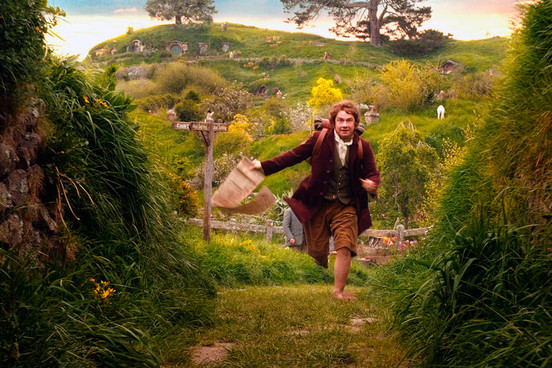
True Life: Bilbo Baggins is my Fashion Icon

Bilbo Baggins in the shire

Photo courtesy of: geeksunleashed.me

There’s a certain jacket I like to wear. It was green once, but has since faded to some kind of grey. The elbows are getting holes in them, and the cuffs are slowly fraying back into balls of thread. I wear this jacket almost every day, regardless of what other clothes I’m wearing or even the temperature outside.

I purchased the jacket for the Hungarian equivalent of $4 on a chilly afternoon in Budapest in May 2010. Some of my closest friends and I had managed to convene partway around the world, and we were doing what we knew best: bumming around and thrift-shopping. The jacket wasn’t really my style – or hadn’t been, at least – but I tried it on and felt something special happen. I felt a transformation and knew that it was my glass slipper, my magic pair of jeans like the ones from The Sisterhood of the Traveling Pants. My friend immediately confirmed the glass-slipper effect, and even though I was slightly broke, I put up the thousand forint required and walked away with an instant favorite piece of clothing.

Over the course of the next three years, it developed a host of memories and some magical powers, powers to tie me to the future and the past in the same moment, to render me both invisible and extremely conspicuous, and to allow me to speak freely and confidently on subjects I know nothing about. It’s been with me to a few different countries, through different stages of my life, various loves and crushes, and a couple career visions. As it’s taken on so many memories and supernatural abilities, it’s lost a bit of its color and the ability to hold itself together and put forward a sharp appearance.

But that’s okay, because we support each other. Where would the memories go, if they weren’t contained in this article of clothing. Where would they fly away to?

Towards the beginning of The Lord of the Rings, with the dark rising in the entire world, all fates rolling towards one impending doom, Bilbo sets out on another journey at last after disappearing from his 111st birthday party. Here’s what Tolkien has to say about those last moments.

He walked briskly back to his hole, and stood for a moment listening with a smile to the din in the pavilion and to the sounds of merrymaking in other parts of the field. Then he went in. He took off his party clothes, folded up and wrapped in tissue-paper his embroidered silk waistcoat, and put it away. […] From a locked drawer, smelling of moth-balls, he took out an old cloak and hood. They had been locked up as if they were very precious, but they were so patched and weatherstained that their original colour could hardly be guessed: it might have been dark green. They were rather too large for him.”

This is the piece of tattered clothing that most people would be inclined to throw away, but it is Bilbo’s own personal suit of armour and the equivalent of my Hungary jacket, the one that ties me to past selves. I can remember every piece of clothing I wore on my journeys, and some of the stories that happened in them. These garments journey with us, to different countries or worlds or states of being, and for me at least they retain some of those journeys and become portals through which I expereince the past and imagine the future.

It’s not fashionable, but it’s meaningful, and I think that’s even better.

I pulled the quote from a full text version of The Lord of the Rings that can be found here. If you liked this article, you might also enjoy: Oh Travel, Why Are You So Magical?, wornstories.com, a website about clothing and memory, and Step Out of the Van and Into a Postcard

Tagged , , , , , , , , ,

A Short History of the List

To-do lists on post it notesOne day I woke up and found lists all around me.

They were telling me what I needed to do, what I wanted to do, restaurants I had to try, the must-read books of the year, bills I hadn’t paid, people who owed me money, action items from meetings I’d forgotten, and other things I absolutely could not forget. The lists covered the walls and lay heaped on the ground, were pouring out of the closet and bursting from drawers.

I was completely surrounded by them and immediately began to panic, the weight of all this crucial information bearing down on me with the force of an anvil, paralyzing me from acting at all or crossing even one item off one list.

So instead of beginning my work, I waded through the lists to my computer and began to procrastinate. I looked up the history of the list.

At the dawn of time, when all the earth’s matter and energy had been vomited up from the great unknown, the sole purpose of each individual bit of matter and anti-matter was this: to become more complex. Billions of years later, after a couple supernovas and other heavy-element producing astrological events, humans evolved and shortly thereafter started wearing trousers. Roughly around that time, the clock was invented. Prior to trouser-wearing and time-minding, the human’s to-do list looked something like this:

1. Survive

Or maybe like this:

1. Obtain food

2. Eat

3. Talk to Mom

At any rate, it was incredibly short because the basic tasks that went into a productive day were obvious and didn’t need to be remembered because if they weren’t, death would result shortly after. But in the time of trouser-wearing, the basic tools for survival became a bit murkier. It was no longer necessary to worry about obtaining food. It was readily available. Survival, too, turned out to be slightly easier than before, due to advances in leeching and humour-reading. All of the sudden, the question of “what do I do now” became much more profound.  It was no longer “what do I need to do today so I don’t die” but “what do I need to do today so I can do what I need to do tomorrow” and so on and so forth in a never ending cycle of perpetual productivity.

That’s when the humans invented lists, an all-powerful demigod that would tell them what they needed to do today in order to prosper tomorrow, or be happy, or avoid debtor’s prison, or remember the things they already knew.

Soon, lists became too complicated to understand, so it was necessary to develop a system where the lists could be listed, organized and distilled into something intelligible. Soon even that was too complicated to understand, so further reduction processes were undertaken and so on and so forth in an eternal battle between existing knowledge, and the desire to remember and act upon it.

There is a legend among the hill people of San Francisco that soon there will be one List that descends from the heavens, restoring order to the world and a sense of purpose, the List to end them all, to forever guide and inform, to comfort and encourage.

Until that day, the list demons proliferate, accusing their victims of sloth, of indirection, of forgetfulness. And the victims accept gladly, and create even more lists. Occasionally, on the most unusual of days, a list gets crossed off completely and disappears. Most often, however, the lists torment the list-maker to a point of madness or indifference, which could be the same thing. It depends on your perspective.

Tagged , , , , , , ,

Where the Muni Buses Sleep at Night

Muni busses at nightMuni buses are the red blood cells of San Francisco, which makes the people the oxygen. The Mission is probably the city’s belly, and Oakland is its liver.

To most people, the buses are ordinary vehicles of public transit, purely utilitarian pieces of equipment with no other purpose besides shifting around the city’s biomass.

But I like to believe the Muni buses have a life of their own, that they think their own thoughts and maybe have crushes on the other bus lines (the 38L is pretty cute), that they have worries and fears and hopes and dreams and that maybe when they grow up, they want to be something like astronauts or ballerinas or social workers and preschool teachers.

They spend all day giving up their bodies to the abuse of a city with many hills, wierdos, fruits, and lots and lots of kale. They ferry the humans and their pets around daily, with some also taking on responsibility for the nighttime people, an entirely different breed. They worry about doing their duties properly, about the weird guy in back bothering their patrons, about their Muni operator who seems to be having a bad day. Just like everyone else, they want to get to where they’re going and want to know that they’ll be safe on the way home at night.

The Muni bus is a social creature, and depends on interaction with others of its kind for personal fulfillment. They greet each other in the streets as they pass, tell each other jokes through the electrical wires and share stories about the crazy and wonderful things that happened to them during the day and at night. They race each other and comment on the quality and personality of other buses’ patrons and on whether or not anyone said thank-you to the operator.

And at night, they all go to the same parking lot, except for the ones out taking care of the night walkers, and they cuddle up together. For a while, as everyone’s arriving there’s plenty of chatter and asking about what the other ate during the day and what did you do and how is your back pain or your friend doing. But then everyone settles into their rows, and the chatter gets quieter, and it’s about deeper concerns and worries. “I just don’t know what to do.” “You can tell me anything.” “I don’t know how to tell her I don’t love her anymore.” “I want to believe there’s something out there but I’m not sure.” “You know we’ll be together always.” “I don’t know…I just don’t know.”

As these words float into the night, the buses drift off to sleep, surrounded by everyone they know, resting for the challenges of the day to come. Under the stars they huddle with the sounds of shifting machinery and deep sighs of loneliness or contentment. They wake early the next morning, ready to do it all over again, wondering if they’ll ever know the answers to their questions.

If you liked this post, you might like Me and God Kicking it at Six Flags and God in the Kitchen, Making Casserole

Tagged , , , , , , ,

The Advice of Mr. Electrico: Live Forever

Mr. ElectricoLast week I read most of an interview with Ray Bradbury in The Paris Review. In it, he describes the altogether unbelievable but hopefully real friendship he had with Mr. Electrico, who might be familiar to you from either the novel or the movie Something Wicked This Way Comes.

According to his story, on the way back from the funeral of one of his favorite uncles, little Ray tells his dad to stop the car. When his dad complies with this ridiculous request (which my own father would have merely laughed at), Ray runs away to the carnival, where he suddenly finds himself face-to-face with Mr. Electrico.

Slightly intimidated, to break the ice, Ray gets a magic trick out of his pocket and asks Mr. Electrico for some expert advice. Seeing from Ray’s pocket inventory that they are of the same fold, Mr. Electrico takes kindly to the boy and shows him around the carnival. As the story gets even more surreal, Ray and Mr. Electrico wind up walking along the shore of Lake Michigan when this conversation happens:

Mr. Electrico says, ” I’m glad you’re back in my life. [Ray says], What do you mean? I don’t know you. [Mr. Electrico] said, You were my best friend outside of Paris in 1918. You were wounded in the Ardennes and you died in my arms there. I’m glad you’re back in the world. You have a different face, a different name, but the soul shining out of your face is the same as my friend. Welcome back.”

One on level, I’m incredibly touched by the sentiment of these statements, of how old friends can be channeled through new faces or even animals (I swear one time the spirit of a good friend communicated with me through an Italian golden retriever), and how there can be familiarity even among strangers. On another, slightly more objective level, this relationship is bizarre. Then again, what should you expect from these two.

That night, Ray goes back to see his new friend at the performance. He recalls the experience,”

Seventy-seven years ago, and I’ve remembered it perfectly […] He sat in the chair with his sword, they pulled the switch, and his hair stood up. He reached out with his sword and touched everyone in the front row, boys and girls, men and women, with the electricity that sizzled from the sword. When he came to me, he touched me on the brow, and on the nose, and on the chin, and he said to me, in a whisper, “Live forever.” And I decided to.

It’s impossible to know whether or not this relationship happened exactly how it’s been portrayed, or if Ray was merely spinning memories every which way out of his geriatric mind, but it doesn’t really matter. I was struck and am still struck by that last statement, “live forever.”

This is how I interpret it: living forever is a choice. It means knowing that the actions of your life can have repercussions far outside of your own existence, and that those repercussions can last longer than you imagine. It means that conventional wisdom is often just that: conventional, and that “You can’t live forever” is not a viable argument, but a blind negation of notion that can be scary. With those words, Mr. Electrico pushed the boundaries of the possible and revealed a bird’s eye view of what life could be.

Life is much more interesting than we make it out to be sometimes. Maybe I should go find my Mr. Electrico and get some weird advice that the Paris Review will want to hear.

What do you think of Mr. Electrico’s statement? Is he just a strange man with some wacky words, or is there something more? 

Tagged , , , , , ,
Design a site like this with WordPress.com
Get started