Tag Archives: funny

Must I Do Homework: An Exercise in the Scientific Method

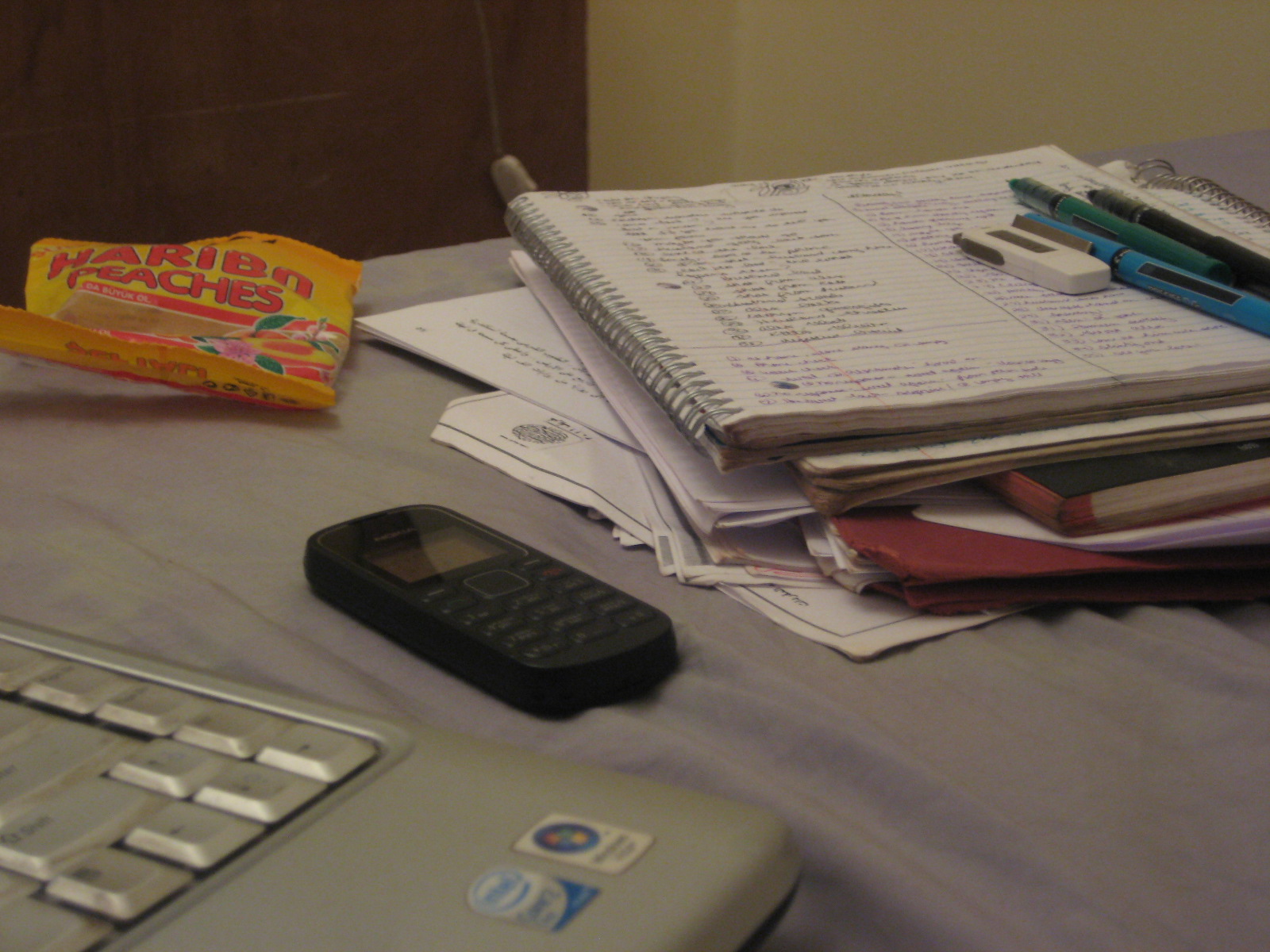
We eagerly await the results of the experiment. Note: real homework is in the corner.

Step one: ask a question

Why isn’t my homework getting done?

Step two: do background research

Current research: This Arabic student has done progressively less homework over the past 4 months despite similar levels of worrying about assignments.

Less current research: During the Arabic student’s second to last semester in college, homework assignments seemed to take up an  inordinate amount of time and be completed at the last minute regardless of when they were started.

Outside sources: According to the internet, homework usually must be completed by an agent other than the homework itself. My mother also recommends that I do it as opposed to not doing it.

Local experts: My own experience indicates that homework usually gets done more quickly if I do it. Also, fellow students who do their homework personally also seem to be continually prepared for class.

Conclusion: There seems to be a lack of research on whether or not mountains of projects complete themselves. Though current knowledge and common sense might indicate that this is probably impossible, if science has taught us anything it’s that nothing is impossible.

Step three: construct hypothesis

My homework, if left undisturbed for long enough in the right conditions, will complete itself with no added energy.

Step four: test with an experiment

After receiving my assignments, I will gently place them in the corner of my room behind the flowery arm chair where they are safely out of the light of the sun and out of my personal eyesight. I will take care of the test specimen by ignoring it completely and doing my best to forget about it. If I have to read anything from a book, I will also place the book behind the armchair and ignore it.

On the assignment’s due date, I will carefully extract the specimen from the corner, being careful not to disturb it too much, and tenderly set it into my bag before taking it to school and presenting it to the teacher without looking at it. At 1 am the following morning, I will board an international flight to a country across a large body of water or land mass.

If no news of my homework reaches me, I will assume it has done itself. Should I find the homework itself, undone, at my residence in the country I have traveled to, I will assume my hypothesis needs more work.

Predicted results:

My homework will complete itself and I will get to spend more time having fun with friends.

Tagged , , , , ,

Say No to the Egg Sandwich

Note: it did not look this good

I have recently tired of my daily falafel sandwich, and have taken to eating the mediocre and overpriced sandwiches from the cafeteria on campus. The main interesting feature about them is that they are cold, whereas the falafel sandwich was hot. This provides me with the variety that spices my life. It doesn’t matter which one you pick, they all essentially taste the same and the meatless ones all cost the same.

Unfortunately, one of these sandwiches provided me with an experience that left me with a valuable lesson and the answer to one of the more important questions of life, that question being:

Should I eat this thing that looks like an egg sandwich the day before I’m going camping?

The answer is no. You should not eat that thing that looks like an egg sandwich the day before you go camping. Here is a non-exhaustive list of reasons why:

1. Regardless of where you are in the world, mayonnaise is essentially a petri dish, a fertile and suitable growing environment for all kinds of bacteria.

2. Even in the states, egg salad is at least 50% mayonnaise. Overseas, this percentage jumps to 70-80%.

3. People seem to believe that an egg sandwich, as a finished product, can be left anywhere for an unlimited amount of time and will not go bad: the backseat in a hot car, on the picnic blanket in the sun, or outside the cafeteria in Cairo. This is patently not true

4. The incredibly mushy texture of the sandwich indicates that the contents of said treat have been pressed together for no small length of time. To someone slightly less hungry with a firmer grasp of common sense, this would be what is referred to as a “bad sign.”

5. The bizarre sweet flavor of the sandwich, and the fact that even after consuming it I wasn’t sure whether or not it had egg in it, also indicate that it was either spoiled or never fit for human consumption in the first place.

At any rate, as a result of said “egg” sandwich, I’ve been subject to one of the most thorough purification treatments I’ve ever had, something rich European ladies would pay thousands for I’m sure.

And the best part of all is that I feel better enough now to go camping! Wish me luck and see you on Tuesday, probably!

Tagged , , , , ,

Jasmine’s Journey to Shubra

Destination: Shubra

The high from her rebellious escape soon wears off as Jasmine becomes stuck in traffic on the way to the city. Sitting on the highway, her tummy rumbles and the possible hour and a half of lurching before her doesn’t bode well for the meal situation. She had wanted room to run and prance and frolick, but now she can barely slam her high heeled snake skin boots to the gas for a split second before she has to switch to the brakes again. What will it take to be free?

After an hour of alternating between creeping and sprinting, Jasmine realizes it might be better to explore this city of hers on foot, the way many Cairenes do. This new idea is intimately related with the fact she totaled her father’s car in a bizarre car accident that left her completely unharmed, and a troupe of mimes in either a state of ecstasy or extreme pain. She bribed all the necessary people and walked away from the smoking, semi-silent mess unscathed, but confused. Where was she?

As she gazes around, cars whizzing by, she only sees an endless horizon of mosques, billboards, more highways, and brown buildings. Is this the people’s Cairo? Carless and clueless, she loiters on the side of the highway like an orphan child until a white taxi pulls up and announces itself: “Taxi?” Having never traveled by herself before, Jasmine is puzzled. What does this common person want? The taxi driver says again, more insistently, “Taxi??”

Finally, she understands and accepts this knave’s services, entering the back of the car and saying she wants to go to “somewhere common, where the people are.” The taxi driver is confused by this. Is this some kind of game? Is it a trick? Is she threatening him? Insulting him?

But no, she really is just that oblivious. Her stomach still growling, she states again that she just wants to go where “normal people live; a people place.” After repeating the word people a few times, the taxi driver finally gets an idea. He’s going to take her to the peopleyiest place all, the place where the popolo congregate, and the public gathers, a place where the common folk thrive and your average Mohammad tells jokes to his grandkids.

“Shubra it is” he says….and off they go.

(to be continued….)

Tagged , , , , ,

At Least We Have the Cappuccini

They don’t do the hearts, but they’re still tasty.

Each week in our Arabic classes, we take on a different theme pertaining to Egyptian society or culture. Unfortunately, the discussions branching from these themes are often depressing.

In a country that has a 20-25% unemployment rate, a weak economy still recovering from the revolution, strained gender relations, rampant urbanization with insufficient accommodation capabilities , deteriorating environmental conditions, an exploding population set to double by 2025, an increasingly tense religious atmosphere, rapidly disappearing natural resources including water, border skirmishes with Israel, a broken political system and growing disillusionment with the political process, skyrocketing food prices,  a 20% poverty rate and 40% adult illiteracy rate, and an egregious gap between the rich and the poor (not as egregious as the one in the United States), sometimes it’s hard to find something pleasant to talk about.

On that note, I’d like to discuss the cappuccino situation at the American University of Cairo: Tahrir Campus. It is fantastic. For only 8 EGP (about $1.20), you can get a delicious espresso drink that is easily just as good as the ones found at nearby Cilantro, Beanos, and Costa Coffee, all of which will set you back at least 15 EGP.

Though the cappuccino I bought yesterday was not as good as the one I purchased on Monday, I have high hopes for the drink I might be purchasing today. And this hope will persevere. I have tasted the foamy, cinnamon sprinkled froth of AUC Tahrir’s espresso machine and I will never forget the sensation of perfect harmony that seeped through my veins upon contact with the exotic elixir.

Nay, though our theme next week be prison literature, or the one after that infanticide, still will the hope churn in my belly for the sweet 45 minute break I have at 10 o’clock, during which I might escape, if just for a moment, from the ever oppressive reality and bury myself in the delightful embrace of the one thing that has never let me down: spending money on coffee in order to lift my spirits.

Some might say I’m ignoring the bigger picture here, and that the fact I can afford to spend 8 EGP on coffee at the most prestigious university in the country without batting an eyelash is an indication of a wider, more troubling social phenomenon. To them I say, “Want a sip?”

Tagged , , , , ,

The Coffee Grinder Saga, Part 2

(This story is continued from yesterday….when I left you I was debating whether or not to plug in someone else’s coffee grinder of unknown current needs into a 220V outlet, a decision that may or may not lead to disaster)

After hesitating briefly, I decided I didn’t need anyone’s help and boldly plugged the coffee grinder into the 220V outlet and flipped the switch. Pop!…..(silence). These are the sounds that came from the machine; they were not the sounds of coffee beans changing into a powdered state.

And just like that, with a friendly popping sound, my life had changed. It seemed the universe was laughing at me.  Why hadn’t there been an earthquake to indicate the scale of the fiasco? Lightening bolts and pigs flying? A flood and a plague of locusts? The catastrophe didn’t seem real. I imagined that if I ran away, the whole problem would disappear as fast as it had surged into existence.

But I didn’t, and the appliance didn’t magically start working when I tried turning it on and off and putting it into the other outlet. It was, as they say, “fried.”  Then I  thought, “It’s just a coffee grinder…how expensive could it be to get a new one?” Even as I thought this, I knew in my heart of hearts that it could be very expensive. I had felt how heavy that machine was. I had seen KitchenAid Pro-Line written on its stainless steel side. This appliance had not been meant for the grubby hands of semi-dedicated Arabic students. How had I dared touch the cooking tools of my superiors?

$250 dollars from KitchenAid.com. That was how much this machine cost. 250 smackaroos, big ones, green backs, etc. That’s approximately 1500 Egyptian Pounds, or half of my monthly stipend, or 375 pounds of falafel sandwiches. My heart sank thinking about all those truckloads of sandwich.

If I could just go back and infuse myself with a desire to go to bed early, or afflict myself with a horrible illness, or make me love learning about voltages and currents, then we wouldn’t be in this situation. And yet, here we are. Here I am. And I will foot this bill like the semi-dedicated Arabic student that I am. Hopefully it can be repaired, but if not, I will cross desert and sea in order to bring back another one. And after that, even though I shouldn’t, I will feel entitled to use it whenever I want to go over even more frequently to the apartment filled with expensive things that break all too easily. Someone else, of course, will plug them in.

My Arabic teacher always thanks us for making mistakes so we can learn from them, so here are some takeaways from this experience so far:

1. Voltages matter.

2. There are some things no amount of education can cure.

3. Expensive things break as easily as cheap things.

4. Running away is always an option.

5. The value of money is relative.

Tagged , , , , ,
Design a site like this with WordPress.com
Get started